

We constantly move between reason and emotion
The almost primitive passion that drives us to continue doing what we love, regardless of the results, because we are fully convinced that education is one of the few real tools for building a more just and caring society. And reason, shaped by culture, pushes us towards the path of “profit,” understood as “anything done without a return is a waste of time.”
At LearningML, we do what we do guided by emotion. Because we believe that, through education, we can change very important things for living in society, such as “not everything you do has to have a return because your own personal satisfaction is already a return in itself.” We trust in computational thinking as a key tool for building analytical, critical, and questioning minds. Minds capable of understanding the world, the rules by which it operates… and transforming it.
However, keeping the infrastructure necessary for LearningML to be available every day of the year, at any time, has economic costs that lead us to be guided by reason:
- Virtual servers in the cloud, with modern infrastructure based on Docker containers and continuous integration that facilitates the deployment of new versions. This allows us to offer a high-availability, high-quality service.
- Domain and email management.
- Administrative and bank account expenses.
To this we would have to add, if we wanted to assess it financially, all the software development and maintenance work, as well as the enormous effort of the communications team: corporate design, logo, dossier, social media campaigns, monitoring, video recording and editing, content creation, etc.
Guided by passion
Until now, all this work has been completely altruistic, guided by our passion for what we do, with the satisfaction of contributing our grain of sand to the wonderful world of education and with the hope of obtaining funding that will not only help cover maintenance costs, but also allow us to continue developing LearningML and new educational tools. But the reality is that these costs, during the five years of the project’s existence, have been covered almost entirely by our personal income.
We are looking for a solution
To solve the financing problem, we decided to create the LearningML association and set up a donation system. However, two years after its creation, this means of financing has not worked.
It is true that we have received some donations, but very few. In 2025, we received a one-off sponsorship from Aprendemanía, which allowed us to cover our expenses for a while. There have also been a dozen donors who initially contributed with one-off donations. And today, we have a single monthly subscription.
It’s clear. We’ve heard it many times and seen it happen: in our Latin culture, donations are not taken very seriously, especially when it comes to products that are offered for free. We don’t usually value other people’s work, especially when we think it’s done “for fun.” How many times have we heard—from bosses, coworkers, friends, or even our own family—phrases like: “It doesn’t cost you anything, if it’s no big deal for you,” “You’re good at those things and you enjoy them,” “It’ll only take a minute”?
And that “little while” actually takes many hours. Hours of study, learning, discussion, trial and error. Invisible hours.
Beyond the passion, the will, the pleasure, and the satisfaction of doing something useful and contributing to the world of education, when a project reaches a certain size, its maintenance and development require funding. It’s that simple, there’s not much else to it. We can continue working “for pleasure” at LearningML (which is debatable, after five years there are other topics that interest us as much or more, and our satisfaction is more than covered), but we cannot maintain the infrastructure without funding
And how do other projects do it?
Let’s think about other technological projects of educational interest. For example, Scratch. Undoubtedly the benchmark for learning to program, used by hundreds of thousands of teachers and students around the world, it offers its code under a free license so that we can study and modify it, thanks to which we have been able to integrate it with LearningML by adding new code for Machine Learning blocks. Would this project be possible without substantial funding? A large part of the budget comes from contributions and donations from large foundations, as well as individual donations and collaborations with public and private institutions.
Let’s think about Moodle, App Inventor, Snap!, GeoGebra. Would they be possible without financial support? If you do a little research, you will find that all these projects have solid funding that combines donations with public-private partnerships.
With all due respect, we know that LearningML is not in the same league as the above applications, but it is still a technological software project and, as such, requires its own infrastructure. Therefore, these examples can help to better understand our situation.
Let’s take a quick look at the numbers
To understand the true scope of LearningML and the necessary expenditure on infrastructure and maintenance, we would like to share data on the project’s evolution over the last three years: number of users and geographical distribution between Spain, America, and the rest of the world.
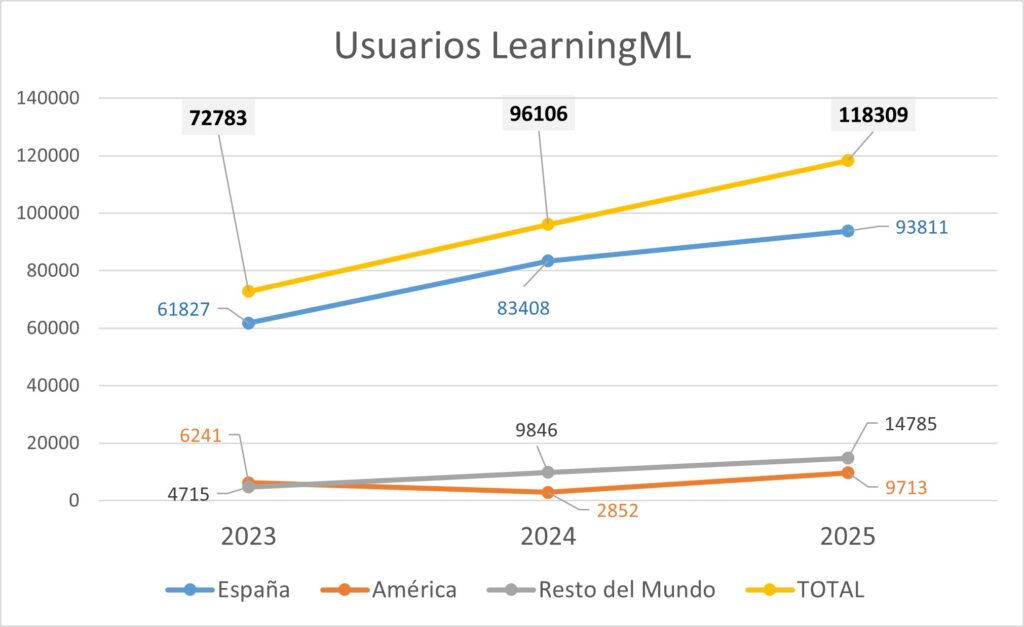
Our goal would be to have similar sources of funding, based on collaborations with the public and private sectors, in addition to donations. This financial support would boost the project by providing stability, i.e., guaranteeing support and availability for the peace of mind of its users. It would enable the development of new features, allowing us to cover more aspects of new advances in AI, computing, and programming, such as generative AI, vibe coding, and quantum computing. And, of course, we would love to open source the code so that anyone interested can study, modify, and use it as they wish, in the style of Scratch, which is our ideal model.
However, so far, our efforts have been in vain. Therefore, before closing the project definitively, out of respect for all the people who use LearningML and all those who have supported us in different ways from the beginning, we have decided that, as of March, we will close all services (due to a lack of financial resources to maintain them) and only a simple website with access to the desktop version will remain available to you.
To reflect, without reproach
We are fully aware of the salary of a teacher in Spain, because we are teachers.
We are also fully aware that it would be appropriate for this type of resource to be financed by the public administration.
And, without wishing to cause controversy, but to add a little humor to all this, let’s fondly remember the great Lola Flores, allowing ourselves to ask the following question for reflection: can you imagine what could have been done if every user in Spain in 2025 (93,811) had donated just €1? If we’ve got this far with practically nothing…
Perhaps it is a cultural issue. We pay €10 a month without thinking twice for entertainment platforms, to which we devote, with luck, a few hours a day. And yet, it is difficult to contribute €1 to a tool that facilitates our teaching work, motivates students, and contributes to improving the quality of education.
Without judging or questioning anyone’s personal decisions—everyone spends their money as they can and as they want, of course!—we want to leave some “open questions” with this decision so that everyone can think calmly about it.
In summary, and as a fundamental idea that we wish to convey: maintaining the LearningML infrastructure costs money. Developing LearningML costs money (time). We cannot continue to fund the project with our own money.
Finally, we have nothing but words of gratitude for all of you who have accompanied and supported us during this time!
We ask for your help in spreading this information, so that no teacher or other LearningML user arrives in class and is suddenly surprised to find that they cannot continue their work in the cloud.